Qui es va casar amb Bridget Haraldsdotter?
Birger Brosa s'ha casat amb Bridget Haraldsdotter .
Inge el Jove s'ha casat amb Bridget Haraldsdotter .
Magnus Henriksson s'ha casat amb Bridget Haraldsdotter .
El matrimoni va acabar el .
Karl Sunesson s'ha casat amb Bridget Haraldsdotter .
Bridget Haraldsdotter
Bridget Haraldsdotter, also Brigida (Swedish: Birgitta Haraldsdotter) (c. 1131 – c. 1208) was Queen of Sweden as the spouse of King Magnus Henriksen.
Brigida Haraldsdotter was the illegitimate daughter of King Harald IV of Norway. Her mother is unknown, but she was possibly Tora Guttormsdotter, long-term lover of her father and the mother of King Sigurd II of Norway. Her Irish first name was the same as that of her father's Irish mother, Brigida O'Brien (d. 1138). According to legend, she was first married to King Inge the Younger, but this is not considered possible; likely, her first marriage was to the Swedish jarl Karl Sunesson. She was married to Magnus Henriksen, son of her stepmother Ingrid Ragnvaldsdotter and Ingrid's first husband, Henrik Skadelår. Her spouse claimed the Swedish throne through his mother in 1160–61. After his death in 1161, she remarried the Swedish jarl Birger Brosa of the Bjälbo family. The daughter she had during her marriage to Brosa, Ingegerd Birgersdotter, was to become Queen of Sweden in 1200 as the wife of Sverker the Younger.
In 1174, the Norwegian throne claimant Øystein Møyla, who claimed to be her nephew, asked for the support of her and her husband, which they also granted. In 1176, the Norwegian throne claimant Sverre of Norway did the very same thing. He was turned away at first, but in 1177, they advised the Birkebeiner to acknowledge Sverre as their King and gave him the support of them and of the Swedish King. Bridget's son Filippus would also join Sverre's service. Brosa died in 1202. In 1205, a conflict broke out between her daughter Queen Ingegerd and the Bjälbo family.
The dates of her birth and death are not known, though her daughter's birth year is set at c. 1180. The dates c. 1131–1208 have been suggested. After the death of her second spouse in 1202, she retired to the Riseberga Nunnery in Närke, where she died and was buried.
llegir més...
Birger Brosa

Birger Brosa († 9. Januar 1202 auf Visingsö) war schwedischer Jarl (Herzog) von 1174 bis 1202 und trug als Wappen eine französische Lilie.
Brosa bedeutet der Lächelnde, dieser Beiname ist allerdings nur in den westnordischen Quellen des 13. und 14. Jahrhunderts bekannt. In den 1180er-Jahren wurde er als dux sveorum bezeichnet.
Er war zu seiner Zeit der mächtigste Mann in Östergötland und besaß neben dem Ahnensitz in Bjälbo mehrere Höfe in Östergötland, Närke und Värmland. Man geht davon aus, dass er ebenfalls Höfe in Södermanland (Sörmland) hatte, da er das Patronatsrecht über die Sankt Eskils-Kirche in Sörmland innehatte. Birger Brosa war ein großer Gönner des Klosters Riseberga.
Nach Hermann von Wartberges Chronicon Livoniae wollte Birger Brosa um 1195 einen Kreuzzug nach Livland unternehmen, sein Schiff wurde aber nach Estland abgetrieben. Nachdem er drei Tage lang das Land geplündert hatte, erklärten sich die Esten bereit, Tribut zu leisten und zum Christentum überzutreten. Nach Annahme des Tributs kehrte Birger nach Schweden zurück.
Er scheint eine Persönlichkeit mit Zugang zu bedeutenden Machtressourcen gewesen sein, die es schaffte, eine lange Friedensperiode in Schweden zu halten. Nach seinem Tod 1202 brachen unmittelbar Machtfehden aus.
Birger Brosa war der Sohn von Bengt Snivil und heiratete vor 1170 Birgitta Haraldsdotter Gille. Sie war eine Tochter des norwegischen Königs Harald Gille und in erster Ehe mit dem 1161 ermordeten schwedischen König Magnus Henriksson verheiratet gewesen. Sie überlebte ihn und trat nach seinem Tod in das Kloster Riseberga ein.
llegir més...Bridget Haraldsdotter
Inge el Jove

Inge the Younger was King of Sweden in c. 1110–c. 1125 and probably the youngest son of king Halsten. According to unreliable traditions, Inge would have ruled together with his brother Philip Halstensson after the death of their uncle, Inge the Elder. In English literature both have also been called Ingold.
Hallstein's sons were Philip and Ingi, and they succeeded to the Kingdom of Sweden after King Ingi the elder. (The 13th century Hervarar saga)
Other sources say that after the death of Philip (1118), Inge the Younger was the sole king of Sweden, but the year of his own death is unknown. According to the regnal list in the Westrogothic law, Inge was poisoned with an evil drink in Östergötland:
Niunði war Ingi konongær, broðher Philipusær konongs, oc heter æptir Ingæ kononge, Halstens konongs brødhær. Hanum war firigiort mæð ondom dryk i Østrægøtlanði, oc fek aff þy banæ. Æn Sweriki for e wæl, mædhæn þer frænlingær rædhu.
The tenth (Christian king) was king Inge, the brother of king Philip, and he was named after king Inge (the Elder). He was killed by evil drink in Östergötland and it was his bane. But Sweden fared forever well, while these kinsmen ruled.
It is not known whether Inge was still alive when the Norwegian king Sigurd I of Norway invaded Småland in the Kalmar Crusade in 1123, but when Inge died, it was the end of the House of Stenkil.
Inge is reported to have been married to Ulvhild Håkansdotter who was the daughter of the Norwegian Haakon Finnsson and who would later marry the Danish king Nils Svensson and even later the Swedish king Sverker the Elder. A story that has her assassinating King Inge with a poisoned beverage cannot be substantiated. According to another tradition, he was also the husband of Ragnhild of Tälje.
llegir més...Bridget Haraldsdotter
Magnus Henriksson
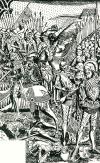
Magnus Henriksson (Danish: Magnus Henriksen; c. 1130 – 1161), also known as Magnus II, was a Danish lord who ruled as King of Sweden between 1160 and 1161. He was descended from King Inge I of Sweden through his mother, and from Sweyn II of Denmark through his father. According to Saxo Grammaticus, he was involved in the assassination of an earlier king, Sverker the Elder, and the Legend of Saint Erik attributes the killing of his predecessor Erik Jedvardsson (Saint Erik) to him. He was recognized as king only in parts of Sweden before being defeated and killed by Karl Sverkersson at a battle in Örebro in 1161.
llegir més...Bridget Haraldsdotter
Karl Sunesson
Karl Sunesson (floruit 1137) est dans la décennie 1130, Jarl de Götaland en Suède.
llegir més...